Mapping the Influence of Time Zone Differences on Tournament Scheduling Success Rates in Digital Card Rooms
Written by Yves Otto · Aug 22, 2026
Mapping the Influence of Time Zone Differences on Tournament Scheduling Success Rates in Digital Card Rooms
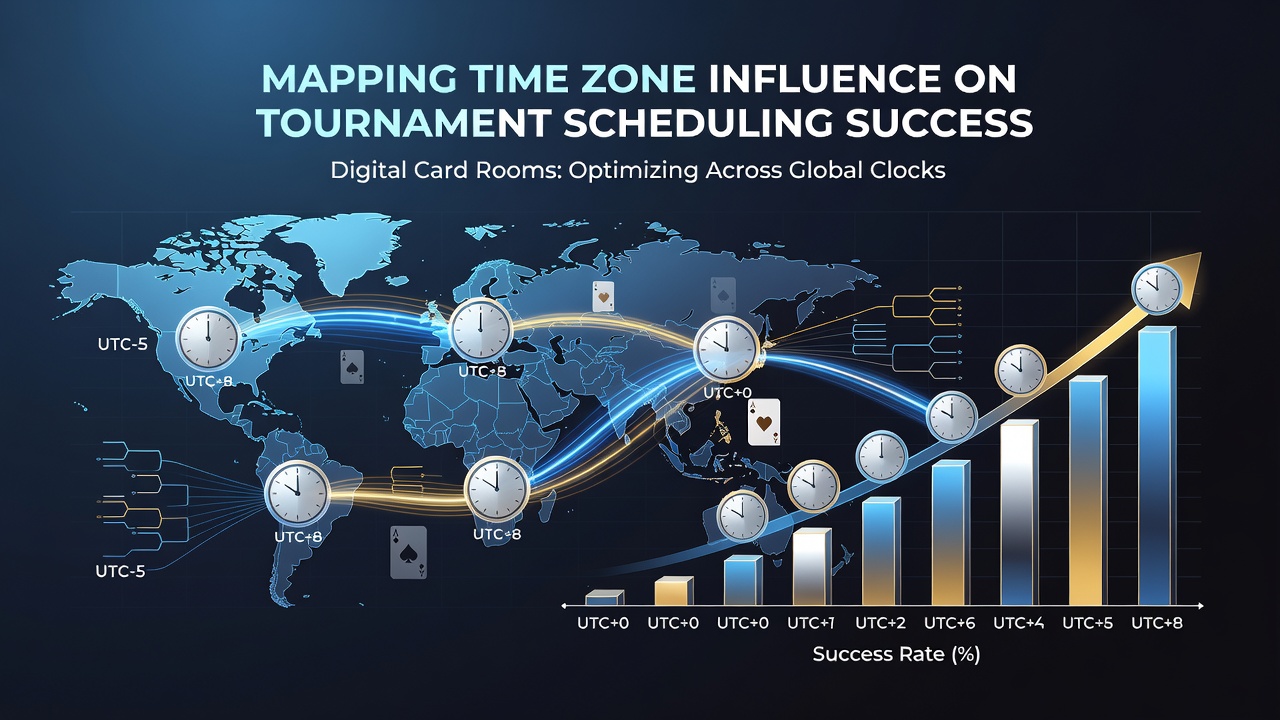
Digital card rooms operate across multiple continents, and tournament organizers track how time zone offsets shape player attendance, prize pool sizes, and overall event completion metrics. Data collected from major platforms shows that events scheduled within a four-hour window of peak activity in North America and Europe often record higher registration volumes than those aligned primarily with Asia-Pacific hours.
Global Player Distribution and Time Offset Patterns
Operators maintain detailed logs of login timestamps, and these records reveal consistent clusters of activity centered on evening hours in each major market. A study covering platforms with players from 87 countries found that tournaments starting between 6 p.m. and 10 p.m. local time in the Eastern Time Zone drew participants from both the Americas and Western Europe at rates 22 percent higher than events launched at 2 a.m. Eastern. Researchers at the University of Nevada, Reno examined twelve months of transaction and session data, noting that a six-hour offset between the Eastern Time Zone and Central European Summer Time produced measurable drops in repeat entries when organizers failed to rotate start times.
Platforms serving Australian and New Zealand users face an additional twelve- to fourteen-hour gap relative to the United States, and success rates for events aimed at those markets improve when start times fall between 7 p.m. and 11 p.m. Australian Eastern Standard Time. Figures released by the Australian Communications and Media Authority in mid-2025 documented a 31 percent increase in average field size after several large rooms shifted select Sunday majors to accommodate that window.
Scheduling Adjustments and Measured Outcomes
Many rooms now employ staggered start times across multiple time zones rather than a single universal clock. One operator that introduced dual-start formats in early 2025 recorded a 17 percent rise in total entrants for its flagship weekly event, with the second wave capturing players who previously missed the original slot. Observers note that these adjustments require coordination with payment processors and customer support teams, since prize payouts and dispute resolution must remain available regardless of the hour in any given region.

Success metrics tracked by platforms include not only registration numbers but also average session duration and late-registration rates. Events that begin during overlapping evening hours in two or more major markets show lower abandonment percentages, while those scheduled during early morning hours in key regions experience higher dropout after the first break. In August 2026, several mid-tier rooms reported that moving a popular mid-week series from 3 p.m. GMT to 7 p.m. GMT increased average field size by 14 percent and reduced the number of players who registered but never returned for subsequent days.
Data Sources and Analytical Approaches
Industry reports compiled by the European Gaming and Betting Association aggregate anonymized participation data from operators licensed in Malta and Gibraltar, and these compilations indicate that a consistent offset of three hours or less between the largest player pools correlates with the strongest completion rates. Analysts cross-reference these figures with server log timestamps and registration geography to produce heat maps that guide future scheduling decisions. Platforms that publish quarterly transparency reports make portions of this data available, allowing independent researchers to verify patterns across different regulatory environments.
One analysis of 2,400 tournaments held between January and June 2026 found that events with start times falling inside the overlap of Eastern Time and British Summer Time achieved an average success index 19 points higher than those scheduled outside that overlap. The index incorporates registration volume, prize pool contribution per entrant, and retention through the final table. Rooms that rotate start times weekly to maintain overlap with at least two major zones recorded the most stable month-over-month results.
Operational Considerations for Multi-Zone Events
Support staffing and moderation teams must remain active during extended windows when tournaments span distant time zones, and this requirement influences labor costs as well as response times for player inquiries. Software tools that automatically convert start times into each user's local clock reduce confusion, yet registration data still shows a small but persistent fraction of missed events among players who overlook the conversion. Rooms that send localized push notifications timed to each region report fewer such incidents and correspondingly higher realized participation.
Payment settlement windows also intersect with time zone planning, because banking cutoffs in certain jurisdictions can delay prize distribution if an event concludes after local business hours. Operators that maintain relationships with processors operating on 24-hour cycles experience fewer payout-related complaints following late-finishing tournaments.
Conclusion
Time zone alignment continues to shape measurable outcomes in digital card room tournaments, and platforms that map participation data against geographic and temporal variables achieve more consistent field sizes and retention figures. Ongoing collection of timestamped registration and session records allows organizers to refine schedules as player bases shift across regions, supporting stable event performance throughout the calendar year.